the hospice
A Dog's JourneyThe hospice is both a place of care and the setting for a reversal in Toby and CJ’s lives: Toby arrives as a young dog brought to visit patients, while CJ eventually comes to live there as one of them. Within its quiet rooms, his learned stillness becomes a form of companionship, and the work of comforting others leads, in the end, to his vigil beside CJ.
Setting and First Visits
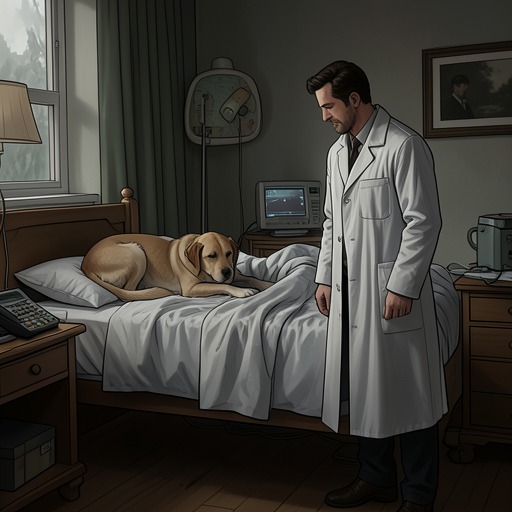
Margaret brings Toby to the hospice by car, where he is delighted to be a front-seat dog, though still too small to put his nose out of the window. The building recalls the room where he once sat with CJ on a couch, but its atmosphere is distinct: he can smell that many people are sick, the floor is soft, and the place is quiet. Some patients pet and hug him; others lie unmoving in their beds and gaze at him. The hospice is introduced through these close, physical encounters rather than through a description of its organization or medical routines.
Margaret carries Toby from room to room and gives him the command Be Still. He understands that ill people need him not to move, and he follows the instruction. He also detects a strong, familiar illness scent on a couple of patients, the same smell that had lingered on Trent’s breath. But he does not signal: he has learned that Pray is the command for alerting someone to that scent, and no one has asked him to do so. The distinction makes the visits more than an extension of his cancer-detection work. Here, his immediate task is quiet presence, and responding appropriately means holding back an alert as well as remaining still.
After the visits, Margaret takes him into a yard enclosed by walls. There Toby runs off his pent-up energy, then shakes and drags a rope with a rubber ball attached, wishing another dog were there to play. People watch him through the windows, and he performs for them. Margaret later reports that the patients love him and that some watched him play in the courtyard; she emphasizes that he did not bark. The courtyard thus gives the hospice’s residents a view of his exuberance without displacing the quiet expected inside.
A Routine of Companionship
Over the following days Toby adjusts to visiting the hospice. Margaret is not there every day, and Fran, Patsy, and Mona also take him to see people in bed. Patsy smells of cinnamon and faintly of dog; unlike Margaret, the other women do not wear flowing clothes. These small observations establish Toby’s own way of distinguishing the people who share the work of bringing him to patients.
The visits take different forms. Some patients want to play, some pet him, and many simply nap while he lies beside them. Toby senses joy from them nearly all the time. Fran praises him as an old soul in a young dog’s body, and he understands the warmth in her voice even without hearing the words good dog. The hospice routine depends not on one prescribed interaction but on his responding to what each person seems to need: activity, touch, or the reassurance of a still companion.
That role recalls the times CJ’s friends came to her and cried while Toby lay beside them on the couch. At the hospice, the pattern broadens: the people he comforts are patients and, at times, their families. His presence is not described as curing illness; its effect is more intimate and limited. He stays close, offers his body to be petted, and shares moments of rest and pleasure amid sickness.
CJ Returns to the Building
When CJ comes back to the building, Toby is initially uncertain. The brown leaves outside are being driven by the wind, and her gait has an unfamiliar hitch: she limps, while a bulky coat hides how frail and thin she has become. Recognition comes with her scent as the door opens. Toby runs to her, careful not to jump in case he knocks her over, and greets her with a wagging tail as she strokes him.
Fran embraces CJ, and CJ puts some things on a desk in one of the rooms. From then on, their old schedule is reversed. Before, CJ left in the morning and returned at night; now she leaves at night and does not return until morning. Toby can still smell that she regularly goes to the room with the couches, but she no longer takes him there. Instead, he stays close as she moves through the building, visiting patients in their rooms, talking with them, and sometimes hugging them.
Toby follows at CJ’s heels. When she leaves at night, a patient often still needs him beside the bed, and family members sometimes hold him. The people who speak with CJ are often in pain, whether they are standing beside a bed or lying in it. After a quiet conversation, Toby senses that their pain has eased a little. Family members reach for him, too, and he lets them hug him for as long and as tightly as they need, even when the embrace is uncomfortable. The hospice therefore joins CJ’s conversation and Toby’s physical comfort in a shared practice of staying with people through distress.
CJ’s Final Stay
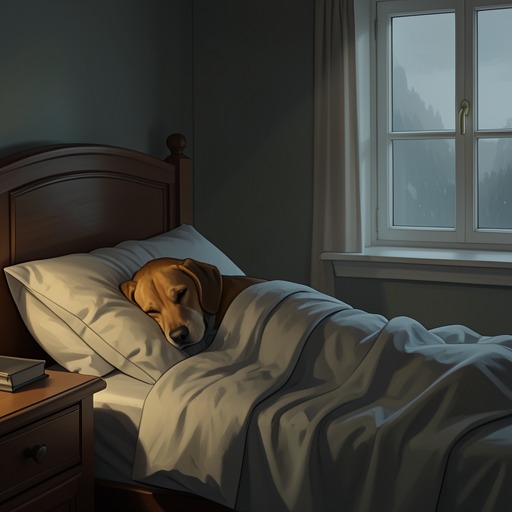
CJ’s return as a caregiver does not remain her only connection to the hospice. A few days after speaking about her wish not to prolong life without regard for its quality, she comes to the building to live. Toby can tell at once that she is sicker than before. He climbs onto her bed and stays there, sometimes near her head and sometimes curled at her feet. The hospice room that had held his visits to other patients becomes the place where he keeps watch over CJ.
As CJ’s voice weakens, she praises Toby and calls him not just a therapy dog but an angel dog like Max and Molly. She tells him she is leaving, that she wants to be with her husband, and that she wants him with her in her final moments so she will not be afraid. She also recognizes him as a friend who has been loved and has had a job, and recalls the gentleness she associates with Molly and the self-assurance she associates with Max. Her words make the hospice a place where their long bond can be acknowledged even as she prepares to die.
CJ dies on a clear spring afternoon. Fran has sat with her all day, while Toby rests with his head on CJ’s chest and her hand loosely strokes his fur. When the hand stops, he looks to Fran; she moves her chair closer and takes CJ’s slack hand. CJ lets go of life bit by bit, and Toby remains beside her until her final breath. Fran calls him a good dog and hugs him as she cries. In the aftermath, Toby remembers Clarity Mahoney as a baby at The Farm and recalls being held by her in earlier lives. The hospice is thus both the site of CJ’s death and a threshold in Toby’s narration: the end of their present life together opens into memories of the care that has connected them across lives.